From Probabilistic to Engineered Venture-Building

You’ll have noticed venture studios have been trending a lot recently. But trends this successful rarely emerge without some sort of structural pressure or a vacuum in the market. And behind the rise of venture studios, there is a deeper truth about the structural gap that existed before it: that the traditional venture capital model (the presumed incumbent in venture building), just wasn’t fit for purpose when it came to solving execution risk. Which is a pretty significant vulnerability, especially for early stage ventures.

For decades, venture capital followed a very familiar formula:

  • Out of ~100 portfolio companies
  • 10% will go on to succeed
  • Of which about 1% goes on (hopefully), to return the fund as a unicorn
  • Offsetting the 90% that failed

(Source: CBS Insights)

And initially, this worked. Especially when startup creation was slower, markets were less saturated, and there was enough information asymmetry for outsized advantages. Great for some of course. Not for most.

But early-stage execution risk remained high and many founders struggled not because the business idea was wrong, but because the operational scaffolding around it was missing. Which is where venture studios have come to dominate.

The Venture Capital Context

The traditional venture capital model evolved around a simple reality: venture returns follow a power-law distribution.

A small number of outlier companies generate the majority of returns, while most investments deliver modest outcomes (or fail entirely). But the returns from these outliers would be such that VCs could afford to take the hit and the early-stage risk that the majority posed.

This reality shaped portfolio construction. Funds were built for breadth rather than precision, with success dependent on capturing the rare breakout winner capable of returning the fund.

But over the past decade, the venture landscape has shifted.

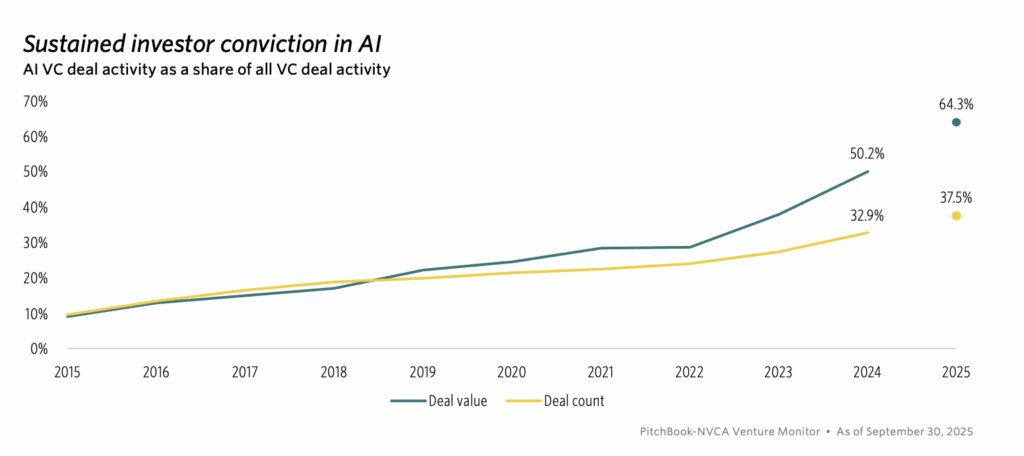
Startups are staying private for longer. Capital is concentrating at later stages. Liquidity timelines are extending. AI has not only compressed build cycles, but more importantly, even in AI-based startups, where capital inflows and valuations have surged, value still remains concentrated among a minority of players.

Which increasingly puts the VC probabilistic model under a lot of pressure.

That’s where the venture studio model has thrived.

Why Venture Studios Emerged

Studios emerged as a response to this gap in the market, addressing that early-stage risk VCs ignored, that was quietly discarding strong innovations and capable founders alike. And to an otherwise fragmented space they:

  • introduced structure
  • embedded operators
  • structured validation
  • created repeatable build processes
  • and centralised resources

Where traditional venture capital relied on portfolio mathematics, venture studios built an entirely different equation.

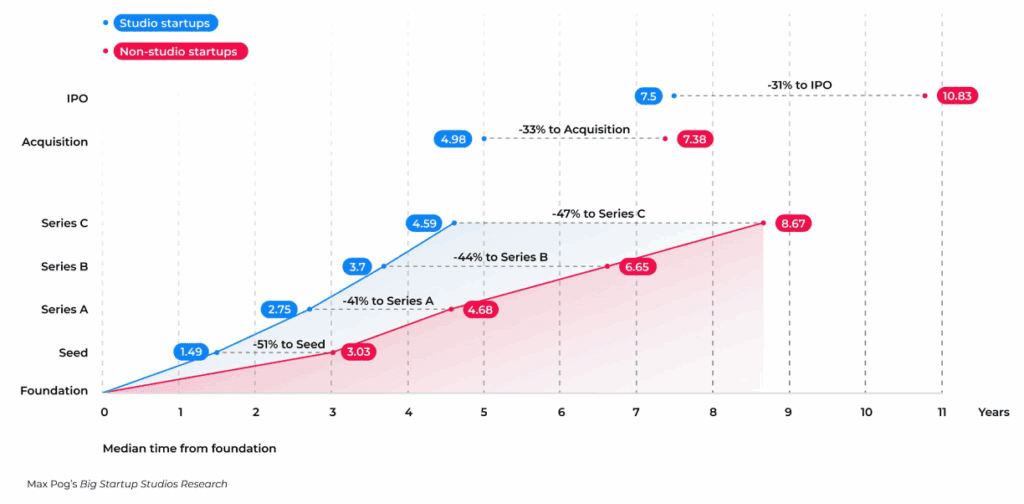
Instead of betting on outliers, studios aimed to systematically increase the proportion of successful companies within each cohort. The objective being that the majority of ventures reach viable outcomes, with 8–9 becoming strong performers (what we refer to as “dragons”), delivering steady growth and meaningful returns.

The remaining companies rarely failed outright. Instead, they would pivot, evolve, or recycle talent and learnings back into the studio ecosystem. Which in turn minimised capital waste and compounded knowledge.

This meant:

  • Instead of betting on teams, studios were now engineering them
  • Rather than waiting for that ‘aha moment’ in product–market fit, they were now accelerating discovery
  • And instead of having pockets of isolated learning, studios were creating a system of compounding intelligence

All of which meant that the prevailing execution risk, that primary failure driver in early-stage ventures, was now structurally reduced.

Which is why venture studios are winning right now (and why you’re probably seeing them everywhere).

But solving execution risk, is only phase one of the evolution.

Because once you start solving execution risk, the next challenge becomes about capital risk.

The Next Frontier: Capital Infrastructure

We have established that venture studios improved execution discipline and reduced early chaos. They also increased output speed and introduced repeatability. All great wins.

But the next edge is no longer just getting execution right, it’s about getting the capital infrastructure right. And already there is a growing shift in investor appetite from just funding isolated ventures, to being part of an engineered venture system. One that’s designed to cover the end-to-end lifecycle of venture-building, addressing execution risk, frictionless capital deployment, more access to opportunities and more data transparency.

The next age of venture-building will belong to operating systems that are capable of delivering:

  • more data-native decision layers
  • structured capital deployment
  • portfolio-level intelligence
  • programmable liquidity pathways

Which feels like a seismic shift from the probabilistic model we had started with. But that’s exactly what this new age of capital intelligence will be: not only disrupting the old power law thinking; but defining new way of approaching venture-building altogether.

And the firms that understand this shift earliest, will be authoring this next chapter.

Final Thought

For institutional capital, the implications are clear: venture-building is moving from intuition-led allocation toward structured, intelligence-driven deployment.

Venturerock is designed for this transition. Integrating venture creation, portfolio intelligence, and capital orchestration within a single ecosystem built for scale, transparency, and compounding performance.

Because in the next decade, venture will not be defined by access alone, but by architecture.

Latest press releases